Welcome
Fortunately within the EU, the 50 year period of copyright on material issued in and upto the 1st half of the 20th century is expiring, moving this material into the public domain.
In combination with electronic distribution, it is possible to share this culturally valuable material where it would not be commercially viable.
- it is therefore primarily intended to promote the appreciation, the preservation and aid research.
The modest intention of this blog is to allow me to highlight some of this material, to perhaps encourage others to discover and enjoy.
If it creates a valid awareness of our rights to access this material, which has often long out of print or available only in very limited numbers, then all the better.
Background
There is a strong difference in the interpretation and enforcement in different countries, particularly with recent legal cases on each side of the Atlantic highlighting these differences.Given the aggressive push by organisations and corporations within the United States, to enforce copyright laws (globally, often to their advantage and effectively erode our rights), it is particularly interesting given the attitude of the United States to others copyright during the 18th and early 19th Centuries.I recommend the article over at wikipedia, to get an overview of the situation, perhaps quite different than you might have thought from impressions given by the Music Industry and their lobbying organs - History of Copyright Law
"In Great Britain's North American colonies, reprinting British copyright works without permission had long happened episodically, but only became a major feature of colonial life after 1760. It became more commonplace to reprint British works in the colonies (mostly in the 13 American colonies). The impetus for this shift came from Irish and Scottish master printers and booksellers who had moved to the North American colonies in the mid 18th century.
They were already familiar with the practice of reprinting and selling British copyright works, and continued the practice in North America, and it became a major part of the North American printing and publishing trade.
Robert Bell was an example. He was originally Scottish, and had spent almost a decade in Dublin before he moved to British North America in 1768. His operations, and those of many other colonial printers and booksellers, ensured that the practice of reprinting was well-established by the time of the American Declaration of Independence in 1776. Weakened American ties to Britain coincided with the increase of reprinting outside British copyright controls.
The Irish also made a flourishing business of shipping reprints to North America in the 18th century. Ireland's ability to reprint freely ended in 1801 when Ireland's Parliament merged with Great Britain, and the Irish became subject to British copyright laws.
The printing of uncopyrighted English works for the English-language market also occurred in other European countries. The British government responded to this problem in two ways: 1) it amended its own copyright statutes in 1842, explicitly forbidding import of any foreign reprint of British copyrighted work into the UK or its colonies, and 2) it began the process of reciprocal agreements with other countries. The first reciprocal agreement was with Prussia in 1846. The US remained outside this arrangement for some decades. This was objected to by such authors as Dickens and Mark Twain."
I don't want to get into a fiery discussion regarding opinion on copyright, I'd like to discuss the actual legalities of copyright law and how they effect material now entering the public domain in some geographical areas and how this effects us, given our present communications inter-connected-ness.
Terms of Use
This space for intended to create a place for encouraging the enjoyment and awareness of older music, often long out of print or available in very limited numbers - it is therefore primarily intended to promote preservation and aid research.Obviously depending upon your present country of residence, downloading and keeping material, in areas other than the EU may breach your country's laws regarding copyright infringement. As a specific illustration, the United States enforces copyright, some 90 years from the date of publishing, whereas copyright in the EU expires after 50 years of either performance or first publication.I therefore ask you to exercise discretion, I must presume you are adults and part of that is exercising a little self-rule, where applicable
- do not download material if you know it is illegal to do so in your country.
This blog is based within the EU and is therefore entitled to discuss and publish material in order to further that discussion.


Miles Davis (tp) J.J. Johnson (tb -1/5) Jimmy Heath (ts -1/5) Gil Coggins (p) Percy Heath (b) Art Blakey (d)
WOR Studios, NYC, April 20, 1953
1. BN477-2 tk.3 Kelo
2. BN478-2 tk.6 Enigma
3. BN479-2 tk.9 Ray's Idea
4. BN480-0 tk.10 Tempus Fugit
5. BN481-3 tk.15 C.T.A.
6. BN482-0 tk.16 I Waited For You
** also issued on Vogue (E) LDE 064 entitled "Miles Davis And His Orchestra": Vogue (F) LD 172 entitled "Miles Davis And His Orchestra, Vol. 2
This is the second installment of Miles on Blue Note (again re-issued on the 1500 Series) - generally a better session. You can see that Blue Note then locenced the recording to Vogue for release outside the US.
For specific tracklistings, have a look at the excellent Jazz Discography Project


Spliced together from 2 different sessions - this release gives you a chance to experience Donaldson, the 'New Face' in different settings (nice tone and not as commercially smooth as later became);
sax, piano, bass, drums and then with trumpet. Interesting to see the dynamic Blakey adds.
Lou Donaldson (as) Horace Silver (p) Gene Ramey (b) Art Taylor (d)
WOR Studios, NYC, June 20, 1952 -
Blue Mitchell (tp -2/4) Lou Donaldson (as) Horace Silver (p) Percy Heath (b) Art Blakey (d)
WOR Studios, NYC, November 19, 1952
For specific tracklistings, have a look at the excellent Jazz Discography Project

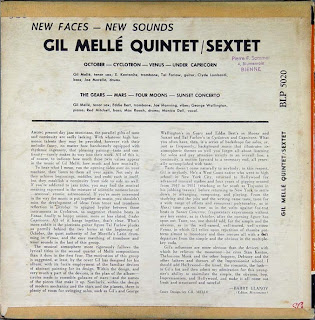
I'm sure you have heard repeatedly that Gil Melle introduced Alfred Lion to Rudy Van Gelder - now I'm not sure, but someone may be able to clarify - this release was actually self produced by Gil Melle, who then hawked it round and it landed at Blue Note. He was the first 'caucasian' leader signed on the BN roster.
Alfred Lion asked WOR how to achieve the RVG sound and they suggested going to RVG. A bit of an 'own goal' for retaining clients, but there you are.
Eddie Bert (tb) Gil Mellé (ts) Joe Manning (vib) George Wallington (p) Red Mitchell (b) Max Roach (d) Monica Dell (vo -2/4)
Rudy Van Gelder Studio, Hackensack, NJ, March 2, 1952
For specific tracklistings, have a look at the excellent Jazz Discography Project


This is a peach of a release - stellar jazzers from the 50's. Britain; Jimmy Deuchar, Johnny Dankworth, Don Rendell - Sweden; Rolf Ericson, Ake Persson, Putte Wickman, Arne Domnerus, Lars Gullin and on and on.
Both sessions were organised by music magazines - then licensed by Blue Note for the US.
Jimmy Deuchar (tp) Eddie Harvey (tb) Johnny Dankworth (as) Don Rendell (ts) Bill LeSage (p) Eric Dawson (b) Tony Kinsey (d)
London, England, July 29, 1950
The British session was assembled by Melody Maker for Leonard Feather. The Swedish session was assembled by Estrad, a Swedish Jazz Magazine (faded away in the 60's) - the group taking the moniker of the poll winners.
Leonard Feather and his Jazz Club USA later organised the Brits again in 1954 for BN 5052 and continued to champion and document the Swedes, with several releases on Prestige.
Rolf Ericson (tp) Ake Persson (tb) Putte Wickman (cl) Arne Domnerus (as) Carl-Henrik Norin (ts) Lars Gullin (bars) Ulf Linde (vib) Bengt Hallberg (p) Sten Harlberg (g) Simon Brehm (b) Jack Noren (d)
Stockholm, Sweden, September 5, 1951
The recording is a little scratchy - this one and 5052 are quite difficult to pick up in decent condition. I have bought 3 different copies over the years from ebay, often described as VG+ (fat chance) - still a slice of Jazz history, hope you enjoy.
For specific tracklistings, have a look at the excellent Jazz Discography Project


Safari
Ecaroh
Prelude to a Kiss
Thou Swell
Quicksilver
Horoscope (Horacescope)
Yeah
Knowledge Box
From Richard Cook's excellent book on Blue Note;
"Lion listened and realised that, while Powell and Monk were the master innovators, Silver was showing how smart, contemporary jazz could be more immediately attractive."
For specific tracklistings, have a look at the excellent Jazz Discography Project


I'm not sure about the release title "Horn of Plenty", but I guess it's connected to Cornucopia, abundance and the supernatural powers which would be given to the person in possession of the horn whatever he or she wished for - quite a good trumpet connection.
This is another Vogue release licensed by Blue Note for distribution in the US. You get two sessions from Paris and if you like Dizzy you won't be disappointed.
For specific tracklistings, have a look at the excellent Jazz Discography Project


This release concludes the 5 volumes of Erroll Garner. I was reading an argument that between Erroll Garner and Oscar Peterson, they really opened up the market and audience for piano based trios in a way that Alfred Lion had hoped that the swingtets might. They got jukebox play and that meant sales exposure.
For specific tracklistings, have a look at the excellent Jazz Discography Project


This was proving to be a popular series of releases for Blue Note. Installment no.4.
For specific tracklistings, have a look at the excellent Jazz Discography Project


I always wondered how Alfred Lion managed to get Miles Davis - in Richard Cook's biography of it explained - Miles was having a desperate year, he was without a regular band and in the grips of chronic heroin addiction.
Against his later session the following year or his Prestige output, this session is not his greatest - but he must enjoyed it enough to want to return two times (leader session + as guest on BLP 1595 for Cannonball Adderley).
I enjoy still his tone and intonation.
You will have heard the tracks on either the 1500 series re-release, along with the alternate takes or the CD re-issue and in the fuller context, these tracks are perhaps better set.
For specific tracklistings, have a look at the excellent Jazz Discography Project


Another record with 2 different sessions, one of those is the great Navarro 1948 session, where McGhee joined in. You heard part of that on the BN 5004 release. I really enjoy Howard McGhee and Navarro for different qualities, so getting both of together again is a treat. Not to mention the allstar cast of Kenny Drew, Max roach, etal.
For specific tracklistings, have a look at the excellent Jazz Discography Project


This 10" is made up from 2 sessions, one of which was actually Monk as leader. Again re-issued on the 1500 series and again on CD. Monk could certainly stretch his bandmates, so it's a pleasure to hear Milt rise to the challenge.
For specific tracklistings, have a look at the excellent Jazz Discography Project
There has been a lot of coverage over the weekend about Rapidshare's actions in Germany.
Doing some digging, (I am not fluent in German or qualified in German law) it seems like the story about Rapidshare could be a getting warped by interested parties in the RIAA friendly media, in that it refers to a raid in Germany, based upon a complaint by German applicants, under German law.
Looking at the court paper - it seems like the request for automatic info disclosure would normally be rejected.
http://www.wb-law.de/news/wp-content/uploads/2009/04/frankenthal-beschluss-06032009.pdf
There is an article- stating that there needs to be intent to distribute large quantities „gewerblichen Ausmaß“ Commercial Scale, i.e. 3000 songs, 200 movies and even then. The clearing of this information would not take place in the civil courts.
Translated;
http://translate.google.com/translate?hl=en&sl=de&u=http://www.wb-law.de/news/it-telekommunikationsrecht/895/lg-frankenthal-setzt-dem-zivilrechtlichen-auskunftsanspruch-des-101-nr-9-urhg-erneut-hohe-huerden/&prev=/search%3Fq%3DChristian%2BSolmecke%26hl%3Den%26client%3Dfirefox-a%26rls%3Dorg.mozilla:en-US:official%26hs%3DIpX
The full story is that it involved an uploader, who persistantly re-uploaded the same Metallica CD, even though, it was being deleted by RS for breach of terms & conditions.
Although it seems to be true, that Rapidshare disclosed the needed IP info.
I think it was given due to the extraordinary circumstances - in German law there are 'special' conditions regarding unrealeased or newly released material and unfair competition.
http://www.gulli.com/news/rapidshare-abmahnung-f-r-2009-04-25/
It is fully inline with a ruling effective since Sept 2008: http://merlin.obs.coe.int/iris/2008/10/article11.en.html
Which is inline with, EU Directive 2004/48/EC
Rapidshare are now a Swiss company, I guess they re-registered and that was part of their transition from .de. to .com. But their servers are in Frankfurt, so are still under German law.
Therefore liable under Section 101 of the Copyright Act (Urheberrechtsgesetz).
However, in the EU the copyright law is 50 years, so upto this point anything published upto and including 1959, is now technically expired and public domain - the Metallica CD clearly does not fall within that range, unlike the Jazz on this blog.


This 10" is the first of a mini series inside the 5000 series, called "New Sounds" or "New Faces/New Sounds" - it's a bit of a mix using sessions recorded by Vogue in both Lausanne and Paris, with a US session. You can create a few themes from the 3 sessions; drummers Roach, Blakey and Terry or the popular Moody.
There was a CD reissue that used a variation for the cover, but did not include all the tracks - so now is your chance to hear the complete BN 5010.
For specific tracklistings, have a look at the excellent Jazz Discography Project


The tracks here were re-released as part of the 1500 series, then again on CD - so there is a good chance you will either have these already or have heard them - but I can't get enough Monk. His 1947 recordings were the first Blue Notes I ever owned, that's going back a little while.
For specific tracklistings, have a look at the excellent Jazz Discography Project


Erroll Garner. A room. A piano. Part 2.
For specific tracklistings, have a look at the excellent Jazz Discography Project


I Hear A Rhapsody (Pt. 1 & Pt. 2)
You Were Born To Be Kissed
Overture To Dawn
These recordings are a bit of a curiosity, they were originally recorded by Baron Timme Rosenkrantz in his apartment in NYC - he owned a recording device, this allowed Erroll Garner to play and then listen back to his recordings. Rosenkrantz was never shy about licensing these recording, so they could be found on various small imprints. What you will notice is that the recording lacks the standards you'd get from the WOR or Van Gelder Studios- but regardless of this the Erroll Garner series was a good seller for Blue Note (five volumes were released).
For specific tracklistings, have a look at the excellent Jazz Discography Project
James Moody and His Modernists with Chano Pozo (1948)


Workshop
Tin Tin Deo
Oh Henry
Mood's All Frantic
Tropicana
The Fuller Bop Man
Cu-ba
Moodamorphosis
For specific tracklistings, have a look at the excellent Jazz Discography Project
James Moody With Strings


Loving You The Way I Do - french title (Aimer Comme Je t'aime)
So Very Pretty - french title (Si Jolie)
Autumn Leaves -french title (Les Feuilles Mortes)
Singing For You - french title (Chanter Pour Toi)
Bedella - as listed on BN, Bedelia as listed by Vogue
Shade of Blond - french title(Une Boucle Blonde)
September Serenade
Jackie My Little Cat
In need of rest and recuperation after suffering under the twin scourges of alcoholism and Benzedrine addiction, saxophonist James Moody backed away from the US scene in 1948 and took off to stay with his uncle in Paris for a couple of weeks, only to remain overseas for three years. During that time he was recorded in various settings settings, if you like his style it's worth tracking down his efforts with Frank Foster and Lars Gullin.
This was originally a session for Vogue under the direction of Andre Hodeir, using alto and tenor saxophones, Moody navigates well even when the ensemble sometimes threatens to engulf him - Blue Note licensed it for release in the US.
For specific tracklistings, have a look at the excellent Jazz Discography Project
Fats Navarro Memorial Album


The Squirel
52nd Street Theme
Lady Bird
The Chase
Double Talk
Dameronia
Our Delight
This 10" collects tracks from four different sessions (one from 1947, two from 1948, one from 1949), I guess probably from his time in New York as part of Tadd Dameron's group. Side Two opens with 'Double Talk' which actually comes from a Bud Powell session in 1949 (he was near the end of his career at this point and plays without the usual power and range - but still beautifully), the side concludes with 'Dameronia' and 'Our Delight' - taken from the 1947 session.
For specific tracklistings, have a look at the excellent Jazz Discography Project


